|
Background of Development, Applications and Advantages
Flying high has always been the passion and Vertical Take-Off and Landing (VTOL) along with stationary position in air has always been the challenge of man and centuries before many tried in vain. Some crashed to death when they tried to imitate birds by flapping their hands fast after jumping from a mountain peak. Thereafter, the concept of 'Bird-Men' came. Leonardo Da Vinci gave the first design via a painting of his for the first flying machine. The credit goes to the Wright Brothers who successfully managed the take-off and landing of an aircraft.
Nevertheless, vertical take-off/ landing and stationary position in the air has always been a better challenge which was solved by the invention of the Helicopter.
The present day Vertical Take-Off and Landing Vehicles [VTOL] which are mainly helicopters use one to four rotors . The blades are very long and take more space than the vehicle. The enlarged size of the rotating blades pose a dangerous situation when the helicopter is on land and can lead to fatal accidents.
The rotors are driven by complex mechanical transmission links. These are extremely complicated in nature and even from maintenance point of view.
SK Dynamics being the strategic partner to Analog Devices Inc., USA (ADI) since 1994 is providing technological solutions on various motor controls, Vibration control systems and DSP applications to ADI and other clients
Having rich motor control experience S K Dynamics set its target on the AVIONICS market by providing High-performance, lightweight motors for Aerospace applications that can be used in VTOL vehicles and can also efficiently replace the Tail-Rotor of the Helicopter.
SK Dynamics with vast experience in electromechanical technology is engaged in the development of lightweight motors & Electrical Transmission based VTOL vehicle (Flying Car) for Avionics Industry using high efficiency Permanent Magnet Synchronous Motors (PMSM) & highly efficient Brushless DC motors (BLDC).
By means of flying car, SKD will demonstrate that an ' Electrical Transmission' based VTOL vehicle will be superior than a 'Mechanical Transmission' based VTOL like Helicopter.
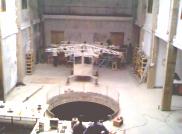
Fig :: Flying Car workshop
Some of the applications of this Flying Car would be:
 |
Fast Transportation at short distances
|
|
|
Immediate rescue operations
|
|
|
Aerial survey
|
|
|
Can be used as unmanned vehicle
|
The advantages of the SKD Flying car over conventional helicopters are :
|
|
Designed to suit electrical power transmission
|
|
|
Less maintenance required as complex mechanical transmission is eliminated
|
|
|
Easy to Fly as compared to existing VTOL, being electronically controlled.
|
|
|
Requires less space for take-off and landing
|
|
|
Upgradable to Hydrogen Fuel Cells or any other electrical power source in future (Reliable and cost effective Hydrogen Fuel Cells are being promised after 2003).
|
|
|
More safe vehicle and better redundancy as multiple rotors are used
|
|
|
Less Acoustic Noise
|
|
|
Cost Effective from futuristic point of view as cost of Electronic control has a decreasing price trend in future
|
Market Trend
With an estimated market of around 20 Billion Dollars per year falling under the category of VTOL and helicopters, which is indeed large enough. Not only the Avionics industry will go for these motors and drive solutions but the automobile sector will also be attracted once they see a real, flying model of a Flying Car.
Development stages of Flying Car
|


